

Hey there! I'm a supplier of PKC Air Cargo Pallets, and I often get asked this question: "How many PKC Air Cargo Pallets can be loaded onto a typical cargo plane?" Well, let's dive into this topic and break it down step by step.
Understanding PKC Air Cargo Pallets
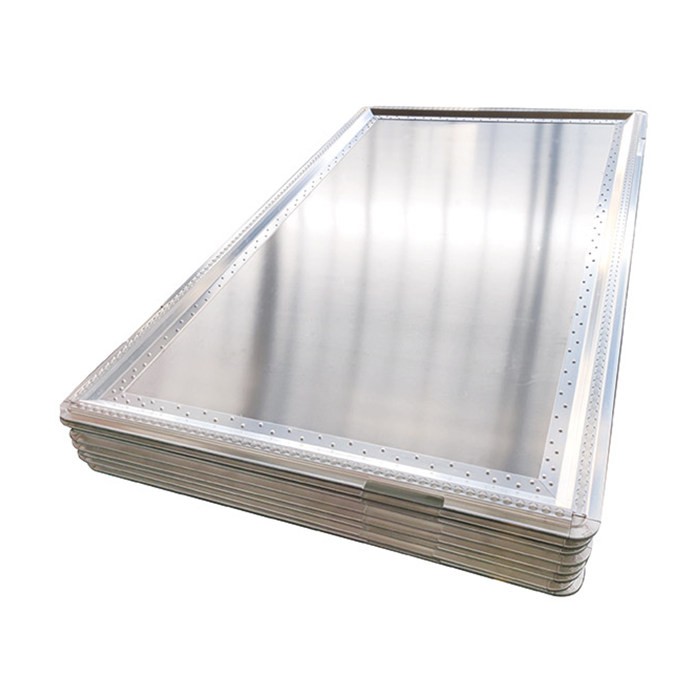
First off, PKC Air Cargo Pallets are top - quality pallets designed to meet the rigorous demands of air freight. They're built to be sturdy, lightweight, and able to withstand the various forces during flight, like vibrations and sudden movements. These pallets come in different sizes and configurations, which is a key factor when it comes to loading them onto a cargo plane.
There are other types of pallets in the market too, like the PLA Air Cargo Pallet, PMC Air Freight Pallet, PMC Aviation Aircraft Pallet, Aircraft Pag Pallet, and Airline Cargo Pallets. Each has its own unique features, but today, we're focused on our PKC pallets.
Factors Affecting Pallet Loading Capacity
Plane Type
The type of cargo plane is the biggest factor. Different planes have different cargo hold dimensions, weight limits, and loading configurations. For example, a small regional cargo plane like the Cessna 208 Caravan has a relatively small cargo hold. It's mainly used for short - haul flights and can carry a limited amount of freight. On the other hand, large wide - body cargo planes like the Boeing 747 - 8F or the Airbus A380F are giants in the sky. They're built for long - haul, high - volume freight transport.
The Boeing 747 - 8F has a huge cargo hold with a volume of about 854 cubic meters. Its main deck can handle large, heavy pallets, and the lower decks are also used for additional cargo. In contrast, the Airbus A380F, if fully configured for cargo, can offer a large amount of space, but its design also has some limitations in terms of how pallets can be loaded due to its unique shape.
Pallet Size and Weight
PKC Air Cargo Pallets come in various sizes. The most common ones are the standard 88 x 125 inches and the smaller 48 x 40 inches. The larger pallets take up more space but can carry more cargo, while the smaller ones are more flexible and can be used to fill in gaps or for smaller shipments.
Weight is also crucial. Each plane has a maximum take - off weight (MTOW) and a maximum payload capacity. The weight of the pallets themselves, along with the weight of the cargo they carry, must be within these limits. If the pallets are overloaded, it can affect the plane's performance and safety.

Loading Configuration
How the pallets are loaded matters a lot. Airlines and cargo operators use specific loading plans to ensure the plane is balanced. An unbalanced load can cause problems during flight, like instability or difficulty in controlling the plane. So, pallets need to be arranged in a way that distributes the weight evenly across the cargo hold.
Calculating the Number of Pallets for Different Planes
Small Cargo Planes
Let's start with small cargo planes. As I mentioned, the Cessna 208 Caravan has a relatively small cargo hold. Its cargo area is about 2.3 cubic meters. If we're using the smaller 48 x 40 inches PKC pallets, which are about 1.6 square feet in area and assuming a height of about 2 feet when loaded with some cargo, the volume of one loaded pallet is approximately 3.2 cubic feet or 0.09 cubic meters. So, in theory, you might be able to fit around 25 - 30 of these small pallets, but in reality, due to the shape of the cargo hold and the need for proper loading and securing, it's probably closer to 20 - 25 pallets.
Medium - Sized Cargo Planes
A medium - sized cargo plane like the Boeing 737 - 400F has a cargo volume of around 150 cubic meters. If we use the standard 88 x 125 inches PKC pallets, which have a larger volume. Let's assume a loaded height of about 3 feet, so the volume of one pallet is about 275 cubic feet or 7.8 cubic meters. Based on volume alone, you could fit around 19 - 20 pallets. But again, considering the weight limits and the need for proper loading, the actual number might be 15 - 18 pallets.
Large Cargo Planes
For large wide - body cargo planes like the Boeing 747 - 8F, with a volume of 854 cubic meters. Using the standard 88 x 125 inches PKC pallets with a volume of 7.8 cubic meters each, we could potentially fit around 109 pallets based on volume. However, the weight limit is a major factor. The 747 - 8F has a maximum payload capacity of around 134 tons. If the average weight of a fully - loaded PKC pallet is about 2 tons, then we're limited to around 67 pallets to stay within the weight limit.
Why Choose PKC Air Cargo Pallets
Now, you might be wondering why you should choose our PKC Air Cargo Pallets. Well, they're made from high - quality materials that ensure durability. They can withstand the harsh conditions of air travel, including extreme temperatures and high - altitude pressures.
Our pallets also meet all the international safety and quality standards. This means you don't have to worry about any compliance issues when using them for your air freight shipments. And because they come in different sizes, you can choose the ones that best suit your cargo needs.
Contact Us for Your Pallet Needs
If you're in the market for high - quality air cargo pallets, look no further than our PKC Air Cargo Pallets. Whether you're an airline, a cargo operator, or a logistics company, we have the right pallets for you. We can work with you to determine the best pallet size and quantity for your specific cargo planes and shipping needs.
Don't hesitate to reach out to us to start a conversation about your pallet procurement. We're here to help you make the most of your air freight operations.