

Why Choose Us
In the Yangtze River Delta region, where China's economy is growing the fastest, Wuxi, the beautiful shore of Taihu Lake, is home to Wuxi Aviation Ground Equipment Co., Ltd., a national high-tech enterprise specializing in the research, production and sales of air cargo equipment products. We specialize in producing Container Metal Door, Aviation DPE Container, LD8 Container, Airline Shipping Containers, AKE Air Cargo Container, Aviation Container, LD2 Air Cargo Container, and other ULD.
Quality Assurance
Our products have passed CAAC CTSOA, CAAC PMA, CAAC MDA, FAA TSOA LODA, CASA ASTO DA, ISO9001:2015, ISO14001:2015, ISO45001:2018, AAA Credit Rating, Ground equipment testing certification of China National Machinery Research Institute, Multimodal transportation industry standard-setting unit, Provincial high-tech enterprise and other certifications.
Products Sell Well
We are exported to Singapore, Australia, Japan, Pakistan and other countries. It is one of the enterprises among similar companies in the china with the largest market share and the most complete varieties of products.
Wide Range of Applications
Our products are widely used in air cargo lift platform, mainly composed of transportation platform, lift structure, lock device, hydraulic system, electrical system, etc., is a combined device for cargo transportation.
Lifetime After-Sales Service
WXHD provides lifelong tracking service for products and offer product training and maintenance service to customers.
-

Container Metal Door
Shipping container doors are the entry and exit points of the container. They are typically located on the end of the container and are made of heavy-duty steel. These doors are designed to be strong Add to Inquiry -
Aviation DPE Container
An intermodal container, often called a aviation container, or a freight container, is a large standardized container designed and built for intermodal freight transport, meaning these containers can Add to Inquiry -
AKE Aircraft Container
AKE containers are equipped with secure locking mechanisms to prevent cargo from shifting during transit. These mechanisms help maintain the stability of the aircraft and protect the cargo from Add to Inquiry -
AKE Air Cargo Container
With the AKE being the most widely used container in the air cargo business, WXHD has over the years developed a formidable range of this vital air cargo transport tool. Our standard products are Add to Inquiry -
Aviation ALF Container
An aviation ALF container is a specialized type of container used in the field of aviation for the purpose of transporting a wide range of goods and cargo via aircraft. These containers are designed Add to Inquiry -
AKH ULD Container
The AKH ULD container is a means of air transportation. It enables cargo to be transported safely, quickly and efficiently on passenger and cargo aircraft. Add to Inquiry -
AAY Container
The AAY Containers are typically constructed from durable materials such as aluminum alloy materials. This construction ensures the containers can withstand the rigors of air travel and cargo Add to Inquiry -
DQF Container
DQF containers play a critical role in modern air cargo logistics by enabling efficient loading, secure transport, and organized handling of various types of goods. Their standardized design and Add to Inquiry -
Aviation DPE Container
Aviation DPE Container is a specialized container designed for transporting various types of cargo within an aircraft. ULD containers are a critical component of air cargo logistics, allowing for Add to Inquiry -
LD2 Air Cargo Container
One kind of container called LD 2 air cargo container is used to carry different kinds of cargo inside of airplanes. ULD containers are an essential part of air cargo logistics because they maximize Add to Inquiry -
LD3 Air Cargo Container
LD3 Air Cargo Containers are equipped with secure locking mechanisms to prevent cargo from shifting during transit. These mechanisms help maintain the stability of the aircraft and protect the cargo Add to Inquiry -
LD3 Aviation Container
With the LD3 being the most widely used aviation container in the air cargo business, WXHD has over the years developed a formidable range of this vital air cargo transport tool. Our standard Add to Inquiry

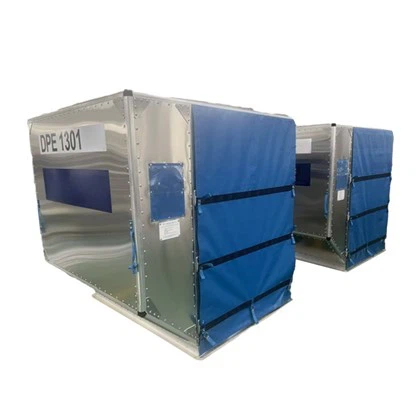


What is ULD
ULD is a device for grouping and restraining cargo, mail and baggage for air transport. This could be either a fixed container or a pallet with mesh or netting to restrain the contents. The metal containers you see at airports used to load cargo, freight or baggage onto aircraft are the most common form of ULD. If you want to know the specifications and prices of ULD, please contact us!
Advantages of ULD
More Efficient Labor
Like other forms of automation, implementing ULD will often translate into significant labor savings. Material transportation can be a low-skill task in most cases. Automating this task allows you to leverage your existing labor for tasks that add more value to your operation, or else reduce payroll expenses. Additionally, because the system can be operated 24/7, multi-shift operations can dramatically reduce staffing requirements.
Fewer Accidents
If you are not leveraging ULD in your operation for staging and storing materials or product, then there is a good chance you are transporting those things using forklifts, which can be prone to aisle congestion and accidents. Operations that switch to ULD will typically see a reduction in accidents, fewer workplace injuries, and less damaged or wasted product. All of this contributes to your bottom line and ROI.
Increased Inventory Visibility
When material is stored and retrieved manually, there is always a possibility that it will be mis-racked or otherwise misplaced within the facility. This lack of inventory visibility causes many problems. Implementing a Unit-Load system removes this challenge, because the system always knows exactly where inventory is placed.
Space Savings
ULD can especially make sense in operations with a small footprint or otherwise limited or shrinking space. This is because implementing the systems will often lead to significant space savings of up to 85%. ULD provides high-density storage and allows you to reduce aisle space, optimize your facility's vertical height to convert open air to valuable storage space.
More Efficiency in Controlled Environments
For operations that are required to store product in refrigerated or frozen environments, AS/RS can lead to improved efficiencies. Humans, naturally, do not work well in such conditions, making them prone to error and accidents. Human workers also typically demand higher pay for working in such conditions. Implementing ULD for tasks in controlled environments will lead to both increased efficiency as well as labor savings.
Additional Functionality
ULD can be leveraged to perform a wide range of applications, from buffering, sequencing to staging and more. Each of these applications has the potential to significantly increase your operation's efficiency and throughput.
Types of ULD
Pallets
Pallets are rectangular platforms used for the efficient loading and unloading of cargo. They come in various sizes, such as the LD3, LD6, LD7, and LD8. LD3 is the most common type and fits in the lower deck compartments of wide-body aircraft.
AKE Containers
AKE containers are also known as "lower deck containers." They have a similar shape and size as LD3 pallets but are enclosed containers with a hinged door. They are often used for the transportation of smaller loose cargo and fit in the lower deck compartments of aircraft.
PMC Containers
PMC (Permanent Main Deck Container) containers are large, rigid containers used on the main deck of wide-body aircraft. They have a higher weight capacity and are typically used for the transportation of bulky or heavy cargo.
PAG Containers
PAG (Palletized Aircraft Container) containers are flat-bottomed containers that fit on the main deck of aircraft. They are designed to accommodate large and heavy cargo and are equipped with rollers or ball mats to facilitate easy loading and unloading.
M1 Containers
M1 containers are lightweight containers primarily used for the transport of mail or other small cargo items. They are typically smaller in size and fit in the lower deck compartments of aircraft.
HMA Containers
HMA (Horse Mule Airdrop) containers are specialized ULDs used for airdrops of supplies and equipment. They are designed to be parachute-dropped from aircraft and often used in military operations.
Things to Note When Using ULD
IATA ULD Regulations
Like many areas of aviation, ULD use today is controlled by IATA regulations. IATA publishes annually updated guidelines - known as the ULD Regulations. These describe standards for construction, sizes and compatibility for ULDs. They also provide important guidelines for handling of ULDs and safe operation. This is more important than it may first sound. According to IATA, repair of ULDs costs the industry $330 million a year, with 80% of this due to incorrect handling. Even more concerning, incorrect ULD handling is quoted as the leading cause of aircraft damage during ground operations - a costly problem for airlines both in repair cost and aircraft utilization.
IATA's regulations contain guidance for operators to correctly handle ULDs in flight, on the ground and in storage. There are regular visual checks that should be carried out, as well as serviceability checks to ensure the airworthiness of ULDs. Particular focus is given to appropriate management of storage of ULDs when not in use, to avoid damage.
Uld Sizes and Aircraft Compatibility
There are two types of ULD - pallets and containers. Pallets are essentially aluminum sheets designed to fit into the cargo hold and lock into place. Cargo is loaded onto the palette and secured in place with nets. Containers are metal construction (usually aluminum), designed to fit the shape of the aircraft and maximize hold utilization.
There are several different types of containers - most of which can fit several aircraft types. The most common containers include:
The LD3 is the most common container. This can be used on all Airbus widebody aircraft, as well as the Boeing 747, 777, and 787. They can also be used on many smaller aircraft, including the ATR 42 and ATR 72 and the BAe 146.
The LD1 container is wider than the LD3 (same height and depth). It is designed for use with the Boeing 747, but the LD3 is often used as it is more commonly available.
The LD2 container fits the Boeing 767s narrower fuselage. The 767 can also take an LD3 container, but it would be inefficient as it takes up the space that two LD2 containers would.
The LD7 is a double-width container (compared to the LD3) that can be used on the Boeing 777 and Boeing 787.
The LD3-45 container is designed to fit the A320 family aircraft. These are standard-sized LD3 containers but with a reduced height to fit the narrowbody smaller hold.
Containers can be recognized on the ground by their serial number. This starts with an IATA-specified code for the container type. The most common LD3 container has a code of AKE, the LD3-45 carried code AKH, the larger LD1 is AKC, and the LD7 is P1P.
IATA regulations also specify the marking that containers should display. These include the IATA type code, the ULD ID code, airline operator codes, and aircraft acceptability.
When you consider how many containers a widebody aircraft can take, you realize the important role ULDs play in cargo logistics. A 747-400, for example, can take 32 LD1 containers on the lower cargo deck and 30 on the main deck (for a freighter aircraft). The 747-8F can take 40 LD1s on the lower deck and 34 on the main deck.
As a few other examples, the 777-300 can take 44 LD3 containers on the lower deck, and the 787-9 can take 36 LD3 containers. The A350-900 can also take 36 LD3 containers (these capacities are based on Boeing and Airbus data).
Don't Forget Manual Loading
ULDs are not used for all aircraft. For completeness, we should also quickly mention manual loading as the alternative. This is the method used on many regional aircraft and often on narrowbodies as well. The A320 family can take reduced size LD3-45 containers, but the Boeing 737 cannot (freighter versions can take ULDs on the main deck though just not in the lower cargo hold).
Manual, or bulk loading, involves handling personnel placing cargo or baggage into the aircraft hold. Nets are used to secure bags and limit movement during the flight.
ULD Management & Control


What Does it Take to Manage a Fleet of ULD?
The short answer to this question is: a lot of hard work, backed up by ample experience. For all airlines, operating wide-body aircraft ULD is an essential part of day-to-day operations, so ensuring that every flight has sufficient amounts of the right types of ULD at the right place at the right time is critical. Given the commercial importance of this function, one would imagine it would receive a certain degree of status within airline operations, but regrettably, ULD control and management is often low in the ranks. This vital function only comes into the spotlight when, for one reason or another, a ULD situation impacts on company operations.
ULD Control and Management Challenges
The biggest issue for any ULD control team is probably the matter of imbalances. One major imbalance that impacts all airlines is the preference for flights originating from certain locations to use a majority of pallets or a majority of containers, while return flights have an opposite preference. This can be due to cargo types or shipper preferences, but, regardless of the reason, it can result in a major overstock of one type of ULD at one location, and an understock of a different type at another location.
Another issue is that the ability of aircraft to carry cargo is impacted by prevailing winds in certain areas. For example, in the northern winter, jet streams blows strongly from west to east, so flights going from Asia to the USA can carry plenty of cargo, while flights returning may take 2-3 hours longer. As such, their load is weight restricted, meaning that some ULD that went to the USA cannot be carried back. Very long flights are especially afflicted by this issue.
Charters to remote airports are also often a source of trouble. The plane, typically a large freighter, lands at a remote location, unloads its cargo, and then quickly departs, leaving behind sometimes more than forty PMC pallets. To counteract load weight and time issues, airlines have asked ULD designers to create a collapsible container for years now, one that can be loaded with cargo in one direction and then return as a flat pack. While this idea has much potential in theory, it has never been realised on a large scale due to the difficulty in arranging for units to be correctly collapsed and packed for transport, and then unpacked and reassembled before re-use. Add into this equation unique positioning needs for special purpose ULD such as temperature controlled containers or horse stalls, and it becomes clear that a typical ULD controller has quite a stressful job.
If the challenges listed above are not enough, their job is made harder by the fact that they often do not receive accurate and timely information about stock and transfer of ULD. ULD controllers rely on the accuracy of data contained in computer systems to properly carry out their jobs, but all too often, data can be mismatched to actual stock levels or locations. Problems generally arise when ULD are transferred to a third, fourth, or even fifth party at a remote station, and that information is not reported back to the ULD control centre. This situation is made worse if accurate and timely stock control checks are not carried out on an agreed schedule, with data regularly reported back to ULD controllers.
Tracking the Location of ULD
For the past thirty years, ongoing efforts have been made to create an automated tracking system for ULD. There has been some limited success, but widespread adoption of any such system remains out of sight. The main reasons for this lack of progress are financial and technical obstacles, and while it would be wrong to rule out the possibility of any such system becoming widely used, the lack of progress over the past thirty years does not offer much optimism. IATA continues to work on industry standards, and technology may give rise to new practical and economic possibilities. In the meantime, however, ULD controllers are forced to rely on transmitted messages and stock reports to locate their assets.
Barcoding systems for ULD fall somewhere in the middle of no tracking system at all and lofty ambitions of RFID tracking or similar. It is relatively easy to attach a barcode to a container, and quite practical to add a barcode sticker to the inside of a pallet seat track. IATA standards for adding barcodes are contained in Section 7 of the ULDR. Having a barcode certainly improves the accuracy of recording a ULD's IATA code details, and given that modern smartphones generally having the capability to read a barcode, this offers a practical and cost-effective alternative to RFID.
Certificate

Our Factory


Frequently Asked Questions
Wuxi Aviation Ground Equipment Co., Ltd. is well-known as one of the leading uld manufacturers and suppliers in China. Please rest assured to buy or wholesale discount uld for sale here from our factory. For price consultation, contact us.
